
Manufacturing environments continue to evolve as product designs become more precise and production requirements more structured. In this context, metal fabrication and welding are often discussed together, yet they serve different purposes within modern manufacturing workflows. Understanding how these processes differ helps businesses make informed decisions when sourcing components, assemblies, and fabricated parts.
Clear distinctions between welding and fabrication services are important for achieving consistent quality and repeatable results.
Understanding Metal Fabrication in Manufacturing
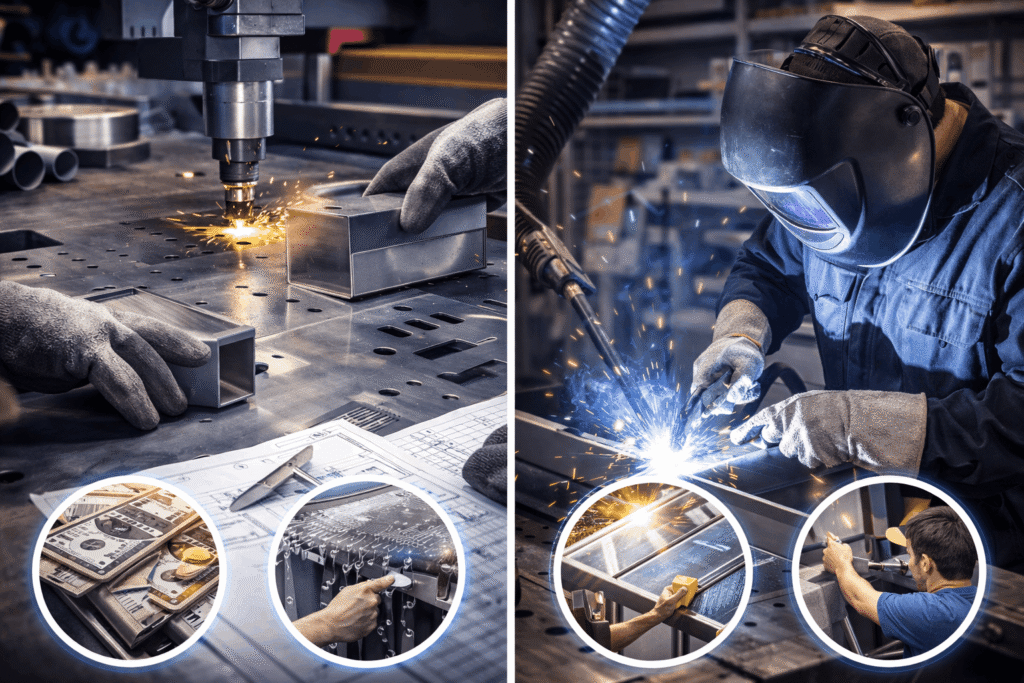
Metal fabrication is a multi-step manufacturing process that transforms raw metal into functional components or assemblies. It focuses on shaping, cutting, forming, and machining materials to meet specific dimensional and performance requirements.
Typical metal fabrication processes include:
- Sheet metal cutting and forming
- Custom metal stamping
- CNC machining using 3-axis equipment
- Tooling and die development
- Simple, repeatable assemblies
Metal fabrication is often used to create precision parts, structural components, enclosures, brackets, and perforated panels that integrate into larger systems across aerospace, electronics, industrial, and medical-related applications.
The emphasis remains on accuracy, consistency, and scalability. Parts must meet drawings, tolerances, and quality standards while remaining easy to reproduce across production runs.
What Welding Represents in Comparison
Welding is a joining technique, not a complete manufacturing system. It involves fusing metal components together using heat, pressure, or filler material. Welding is often one step within a broader fabrication process.
In manufacturing settings, welding is typically used to:
- Join pre-fabricated metal parts
- Strengthen structural connections
- Assemble frames or supports
- Secure brackets, fasteners, or housings
Welding services alone do not shape raw materials into finished components. Instead, it supports the final assembly or structural integrity of parts that have already been fabricated.
Key Differences Between Metal Fabrication and Welding
Although related, welding and fabrication services differ in scope, function, and outcome.
Metal fabrication focuses on:
- Transforming raw metal into finished or semi-finished parts
- Dimensional accuracy and repeatability
- Integration with machining, stamping, and tooling
- Production efficiency and scalability
Welding focuses on:
- Permanently joining metal components
- Structural reinforcement
- Assembly support within fabrication workflows
In modern manufacturing, welding is often one element within a fabrication project rather than the primary process.
Why Metal Fabrication Plays a Broader Role
Metal fabrication supports manufacturers that require consistent, high-volume, or precision-based components. Processes such as stamping and CNC machining offer tighter tolerances and greater repeatability than standalone welding operations.
This approach benefits industries where:
- Parts must meet strict quality standards
- Documentation and traceability are required
- Assemblies need to remain simple and repeatable
- Long-term production consistency matters
By contrast, welding-intensive projects are more suitable for structural frameworks where dimensional variation is acceptable.
How Fabrication and Welding Work Together
In many applications, welding and metal fabrication complement each other. Fabricated parts are first cut, formed, or machined. Welding is then applied selectively to join those parts into a finished assembly.
This structured approach ensures:
- Fabricated components meet design intent
- Welds are applied only where needed
- Assemblies remain consistent across production runs
Maintaining this balance helps reduce rework, material waste, and variability in finished products.
Choosing the Right Process for Manufacturing Needs
Selecting between fabrication-focused or welding-focused solutions depends on production goals. Businesses requiring precision parts, stamped components, or machined features often benefit from fabrication-led workflows. Welding becomes supportive rather than central.
Factors that influence this decision between welding and fabrication include:
- Required tolerances
- Production volume
- Assembly complexity
- Regulatory or quality requirements
Clear alignment between process capabilities and project needs supports better outcomes over time.
Final Thoughts on Fabrication vs. Welding
Custom welding and fabrication each serve a purpose in modern manufacturing, but they are not interchangeable. Fabrication provides the structure, precision, and repeatability needed for scalable production. Welding supports assembly and structural integrity within that framework.
For organizations evaluating metal fabrication and welding fabrication companies in Canada, understanding these differences is essential. It helps streamline sourcing decisions and align manufacturing strategies with long-term production goals.