
Process units utilizing demister pads rely on consistent removal of entrained liquid droplets to protect downstream equipment, stabilize operations, and meet stringent emissions regulations. When a demister mist eliminator underperforms, the consequences are often immediate: visible mist carryover, corrosion, fouling, or unexpected pressure losses, all of which compromise plant reliability and escalate operating expenditures.
Underperformance in a demister mist eliminator installation is rarely attributable to a singular deficiency. More commonly, it results from a confluence of design, operational, installation, and maintenance variables. Employing a structured troubleshooting methodology enables engineers to isolate root causes and restore robust separation performance without resorting to inefficient trial-and-error practices.
Defining Optimal Demister Mist Eliminator Performance
Optimal performance is characterized by:
- Efficient droplet capture within the design separation efficiency range
- Stable and predictable pressure drop
- Unimpeded liquid drainage
Coalesced liquid must exit the demister pad without re-entraining into the gas stream, while downstream process equipment remains free from mist-induced fouling or corrosion.
Indicators of Poor Demister Performance
Early warning signs include:
- Visible mist carryover
- Incremental increases in differential pressure
- Liquid accumulation upstream of the demister media
- Contamination in downstream equipment
Occasionally, a reduction in pressure drop may indicate gas bypass or internal damage rather than improved performance.
Common Causes of Demister Mist Eliminator Underperformance
- Inaccurate Demister Selection: Selecting a demister pad without rigorous consideration of droplet size distribution, gas velocity, liquid loading, or chemical composition often leads to inadequate performance. Demisters specified for low mist loads may experience flooding or re-entrainment under elevated liquid rates or process upsets.
- Gas Velocity and Flow Distribution Irregularities: Excessive superficial gas velocity diminishes capture efficiency and increases shear forces, fragmenting coalesced droplets back into fine mist. Deficient inlet geometry, insufficient flow straightening, or internal obstructions can generate uneven flow distribution, overloading select regions of the demister while leaving others underutilized.
- Liquid Loading and Flooding: When liquid loading surpasses the drainage capacity of the demister pad, pooling occurs within the media. Flooding produces sharp pressure drop increases and elevated re-entrainment rates, commonly observed during transient operations such as startups, shutdowns, or process excursions.
- Fouling and Media Plugging: Accumulation of solid particulates, viscous condensates, or polymerized compounds reduces effective open area within the demister mist eliminator, increasing pressure drop and diminishing capture efficiency. Media selection, material compatibility, and inspection cadence significantly influence fouling resistance.
- Drainage Failures and Re-Entrapment: Adequate drainage is critical for sustained separation performance. Insufficient clearance beneath the demister pad, damaged support structures, or improper orientation can trap liquid within the media, facilitating re-entrainment even when theoretical capture efficiency remains high.
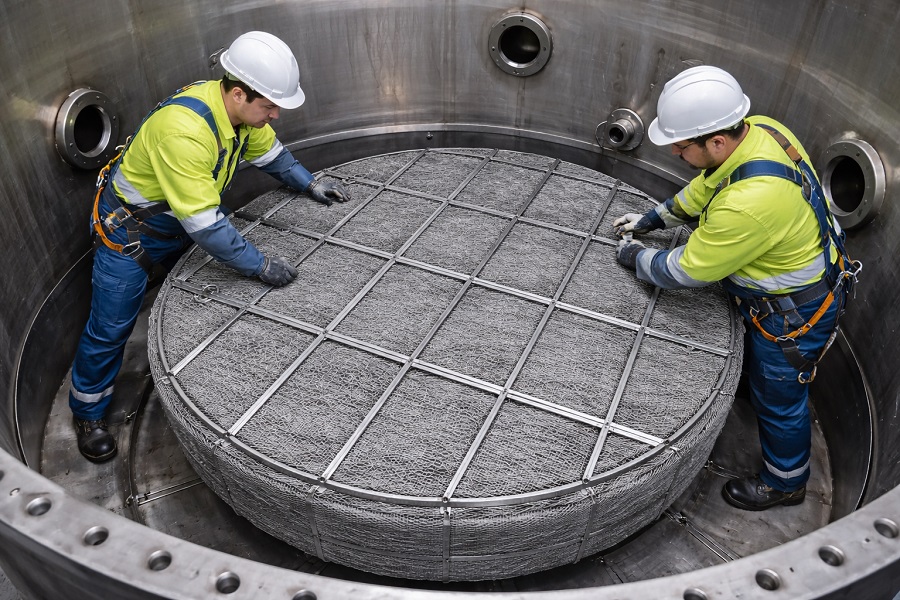
- Installation and Mechanical Fitment Errors: Mechanical inconsistencies—gaps between the demister frame and vessel wall, inadequate gasketing, or improper compression—allow untreated gas to bypass the demister mist eliminator, severely reducing overall separation efficiency.
- Material Degradation: Chemical attack, thermal stress, or erosion can compromise demister media integrity. Loss of wire mesh cohesion or altered pad geometry affects droplet capture and drainage, producing a gradual performance decline.
Pressure Drop Diagnostics
Monitoring pressure drop provides critical insight:
- Gradual increases typically indicate fouling or flooding
- Sudden decreases may signify internal collapse, damage, or bypassing
Routine pressure drop tracking allows early identification of performance deviations before visible carryover manifests.
Maintenance-Related Issues
Inconsistent inspections, delayed cleaning, or improper reinstallation can impair demister mist eliminator performance. Cleaning methods must align with media material and contaminant type to preserve structural integrity and separation efficiency.
Systematic Troubleshooting Approach
Effective troubleshooting begins with a review of original design assumptions versus current operating conditions. Key steps include:
- Visual inspections of demister pads and support structures
- Differential pressure analysis
- Drainage evaluation
- Flow distribution assessment
A methodical approach prevents repeated failures and ensures operational continuity.
Upgrading or Redesigning the Demister System
Changes in throughput, feed composition, or emissions requirements may exceed the capacity of existing demister mist eliminators. Upgrading to higher-capacity media or redesigning the system often provides superior long-term reliability compared to recurring maintenance interventions.
Best Practices for Sustained Performance
Preventive strategies include:
- Conservative velocity and flow distribution design
- Compatible material selection for chemical and thermal resistance
- Adequate drainage clearance
- Defined inspection and maintenance schedules
Engaging experienced demister pad suppliers ensures informed decisions regarding lifecycle, material selection, and operational performance.
Ensuring Reliable Demister Mist Eliminator Operation
Reliable performance is contingent upon precise demister pad selection, meticulous installation, and disciplined maintenance. Understanding the interplay between operating conditions and demister media characteristics enables early detection of issues and sustained separation efficiency.
With decades of expertise in high-performance separation technologies, Kimre collaborates with leading demister pad suppliers to diagnose operational challenges and engineer robust, compliant solutions. Connect with Kimre to evaluate demister mist eliminator systems and implement designs optimized for long-term reliability and emissions compliance.