
Many electronic products fail not because of poor manufacturing but because of overlooked design decisions made early in development. These issues often remain hidden until production begins, leading to delays, rework, and increased costs. In critical industries, even minor design flaws can affect performance, compliance, and reliability.
This is where the connection between design and PCB assembly becomes critical. Star Engineering Inc. supports businesses by customizing circuit boards and aligning design with real-world assembly requirements.
Why PCB Design Directly Impacts PCB Assemblies
PCB assemblies depend heavily on design accuracy. Even well-equipped assembly processes, whether SMT (surface-mount technology) or through-hole PCB assembly, cannot compensate for flawed layouts.
Design decisions influence:
- Assembly efficiency
- Component placement accuracy
- Thermal stability
- Signal performance
- Long-term reliability
When design and assembly are aligned early, production becomes more predictable and scalable.
1. Poor Component Spacing in PCB Assemblies
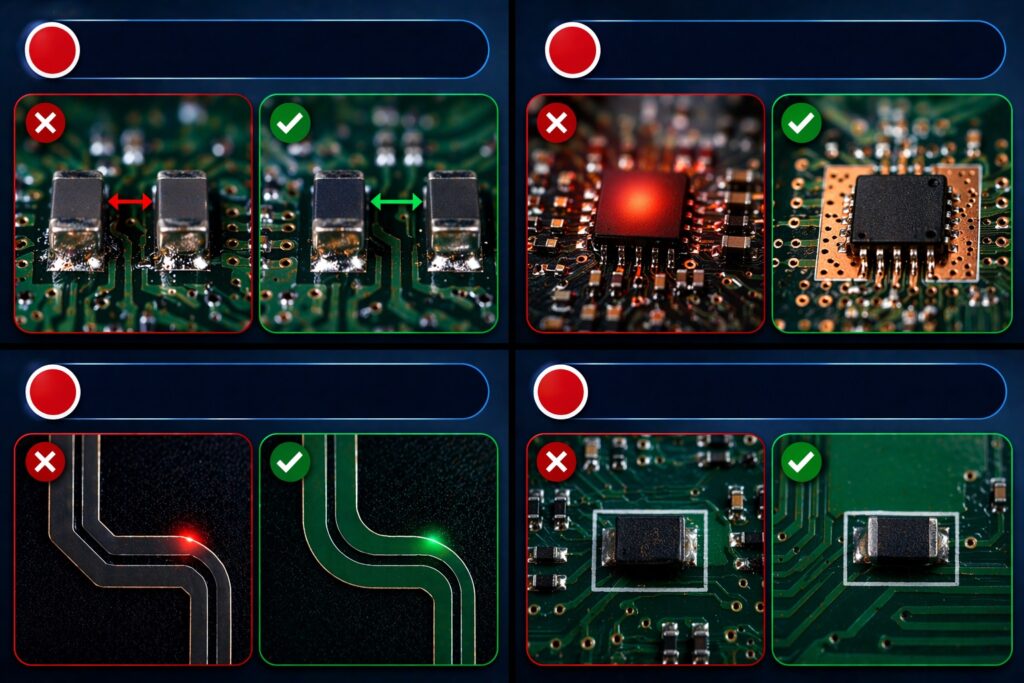
Improper spacing between components is a common issue in PCB assemblies. Tight layouts may seem efficient, but they often create assembly challenges.
Key risks include:
- Difficulty in automated placement during SMT processes
- Increased chances of solder bridging
- Limited access for inspection and rework
- Interference between adjacent components
Prevention approach:
- Maintain proper spacing guidelines based on component size
- Consider tooling and inspection requirements
- Validate layouts against assembly capabilities
Balanced spacing improves both manufacturability and long-term performance.
2. Thermal Management Issues in PCB Assemblies
Thermal issues can compromise PCB assemblies, especially in high-power or compact designs. Without proper heat dissipation, components may degrade or fail prematurely.
Common issues include:
- Overheating of sensitive components
- Warping of the PCB
- Reduced the lifespan of electronic assemblies
Prevention approach:
- Incorporate heat sinks, thermal vias, and copper pours
- Analyze heat distribution during the design phase
- Align thermal design with real operating conditions
Thermal planning is especially important in applications such as automotive systems, aerospace electronics, and medical devices.
3. Signal Integrity Issues in PCB Assemblies
Signal integrity plays a major role in the performance of PCB assemblies. Routing errors can introduce noise, delays, or interference.
Typical challenges include:
- Crosstalk between signal traces
- Impedance mismatches
- Poor grounding strategies
- Excessive trace lengths
Prevention approach:
- Follow controlled impedance guidelines
- Use proper grounding and shielding techniques
- Optimize trace routing for high-speed signals
This becomes critical in communication systems, RF coaxial cable assemblies, and advanced control panels.
4. Lack of Design for Manufacturability (DFM) Considerations
One of the most overlooked issues PCB assembly manufacturers face is the lack of design for manufacturability (DFM). A design may function well in theory but create inefficiencies during production.
Common consequences:
- Increased assembly time
- Higher defect rates
- Greater production costs
- Delays in scaling from prototype to production
Prevention approach:
- Collaborate with assembly teams early
- Validate designs against real manufacturing processes
- Consider material selection, tolerances, and assembly methods
DFM ensures smooth transitions from design to full-scale production.
How These Mistakes Affect Production and Costs
Hidden design issues can significantly impact production outcomes.
Key effects include:
- Increased rework and scrap rates
- Delayed timelines due to redesigns
- Higher labor and inspection costs
- Reduced product reliability in the field
For industries such as aerospace and defense, and medical, these risks can also affect compliance with safety standards.
Efficient production depends on design accuracy, process alignment, and strong supply chain coordination.
The Role of Engineering Collaboration in PCB Assemblies
Design issues often go unnoticed until they affect production, cost, and performance. Addressing issues such as component spacing, thermal management, signal integrity, and manufacturability early can significantly improve results.
Strong collaboration between design and manufacturing teams helps prevent these issues early. Engineering support plays a key role in aligning product design with assembly capabilities.
Collaborative benefits include:
- Improved integration with electromechanical assembly
- Better coordination with custom cable assembly and wire harness applications
- Efficient development of box build assembly
- Streamlined supply chain management and inventory planning
From multi-conductor cable assemblies to military assemblies, integrated engineering reduces risk and improves production outcomes.
Star Engineering Inc. supports businesses by customizing circuit boards and aligning design with assembly processes across multiple industries.
Contact Star Engineering Inc. to learn how tailored PCB assemblies in the USA can support reliable production.