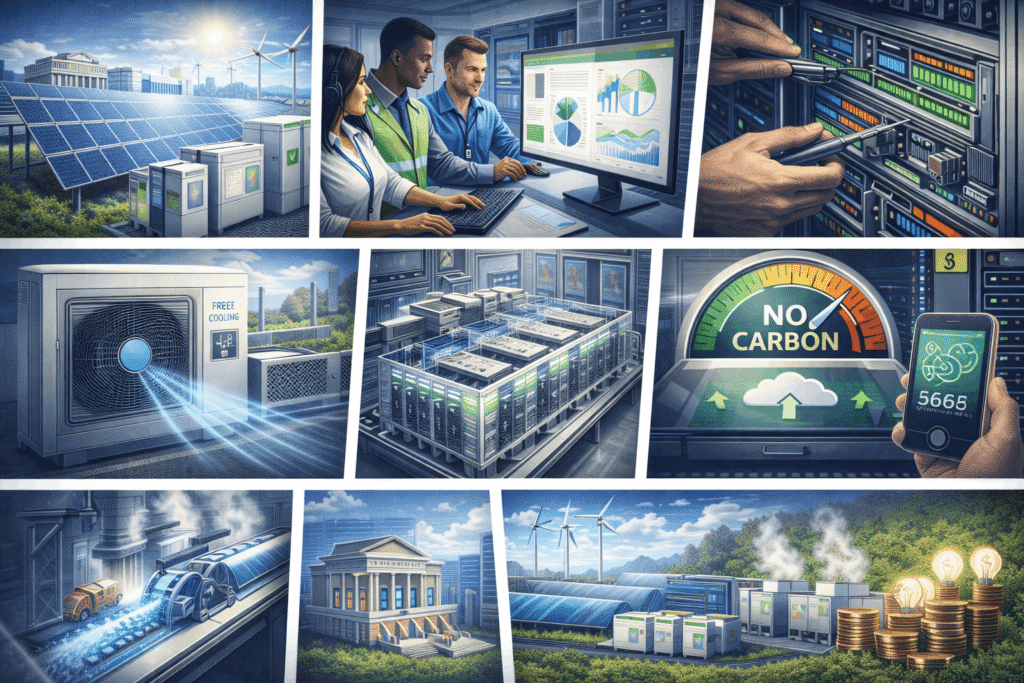

Banks continue expanding digital services while facing higher electricity prices, tighter operating margins, and growing regulatory scrutiny. Legacy data center infrastructure struggles under constant transaction loads, inefficient cooling systems, and exposure to volatile grid pricing. A green data center powered by on site renewable energy gives banks a way to stabilize energy spend while maintaining security, uptime, and compliance.
1. Rising Energy Costs in Traditional Banking Data Centers
Traditional banking data centers rely on centralized grid power with volatile pricing and escalating demand charges. Transaction peaks increase energy spend, while aging cooling systems add inefficiency. These factors drive unpredictable operating costs across core banking systems.
A modern financial data center reduces these issues by shifting power generation closer to compute loads. On-site renewable energy lowers exposure to grid instability. Banks gain better control over operating expenses and long-term energy planning. According to industry benchmarks, cooling systems account for roughly 40 percent of total data center electricity use, amplifying cost exposure in older facilities.
2. Renewable Power as a Cost Control Strategy for Banks
Renewable energy improves cost predictability for banking infrastructure. On-site solar generation paired with battery storage reduces dependence on external utilities and limits exposure to energy price swings. This structure supports stable budgeting across continuous transaction cycles.
For a data center for banks, renewable generation paired with battery storage supports consistent budgeting across peak trading hours and continuous digital operations. Over multi year planning cycles, on site energy infrastructure reduces exposure to utility price adjustments and demand charge escalation.
3. Modular Data Center Design and Energy Efficiency
Modular data center design allows banks to scale power and cooling capacity in step with transaction growth instead of building oversized facilities upfront.
Incremental expansion reduces wasted energy and avoids oversized facilities. Integrated systems improve efficiency while supporting steady digital growth.
A modular financial data center integrates cooling, monitoring, and power systems into a compact footprint. Shorter airflow paths improve cooling efficiency. Energy losses decline, and operating costs stay aligned with transaction growth.
4. Distributed Architecture and Reduced Power Waste
Centralized banking data centers increase energy use through long transmission paths and concentrated cooling loads. Distributed deployments shorten data travel distance and reduce power loss. Processing transactions closer to users improves efficiency and resilience during regional disruptions.
A data center for banks built on distributed architecture processes data closer to users and transaction sources. This reduces network congestion and energy waste. It also supports uptime during regional grid disruptions.
Shorter transmission distances reduce energy losses associated with centralized power delivery.
Smaller facilities lower cooling demand and improve thermal efficiency.
Distributed deployments improve resilience during regional grid outages or weather related disruptions.
5. Colocation Models That Lower Energy Overhead
Colocation models reduce energy overhead by sharing optimized power and cooling infrastructure across tenants. Banks avoid maintaining private facilities while retaining control of sensitive workloads. Access to renewable-powered sites improves efficiency without large capital investment.
Colocation also enables access to renewable-powered sites without direct capital investment. This structure lowers total cost of ownership and simplifies infrastructure management.
6. Advanced Cooling Systems That Cut Power Consumption
Cooling represents one of the largest drivers of data center electricity consumption. Green data centers rely on modern thermal management systems that adjust cooling output based on real time workload demand rather than fixed operating assumptions.
These systems reduce overcooling and adjust dynamically to workload changes. For a financial data center, this results in lower energy draw during off-peak periods and stable performance during high demand. Power efficiency improves across full operating cycles.
7. Long-Term Cost Stability Through Green Data Centers
Banks operate on long planning horizons where energy volatility introduces financial risk. Green data centers powered by renewable energy deliver predictable operating costs over time. This stability supports audit readiness, compliance planning, and sustainable digital expansion.
A data center for banks powered by renewable energy provides predictable operating costs over long planning horizons. On site solar generation and battery storage reduce exposure to energy market volatility while optional backup systems maintain uptime during grid outages.
Building Cost-Efficient Banking Infrastructure With Flux Core Data Systems
Flux Core Data Systems deploys modular, renewable powered distributed data centers designed for banking workloads. Systems reach operation in as little as 90 days and operate on resilient on site energy, giving banks secure, low latency infrastructure without long interconnection delays.
Banks gain secure, low-latency infrastructure without hyperscale delays. Through Compute Purchase Agreements, Flux Core delivers compliant, on-demand compute aligned with energy efficiency goals.
Contact Flux Core Data Systems to deploy a renewable powered data center for banks that stabilizes energy costs, supports compliance requirements, and scales securely with digital banking demand.