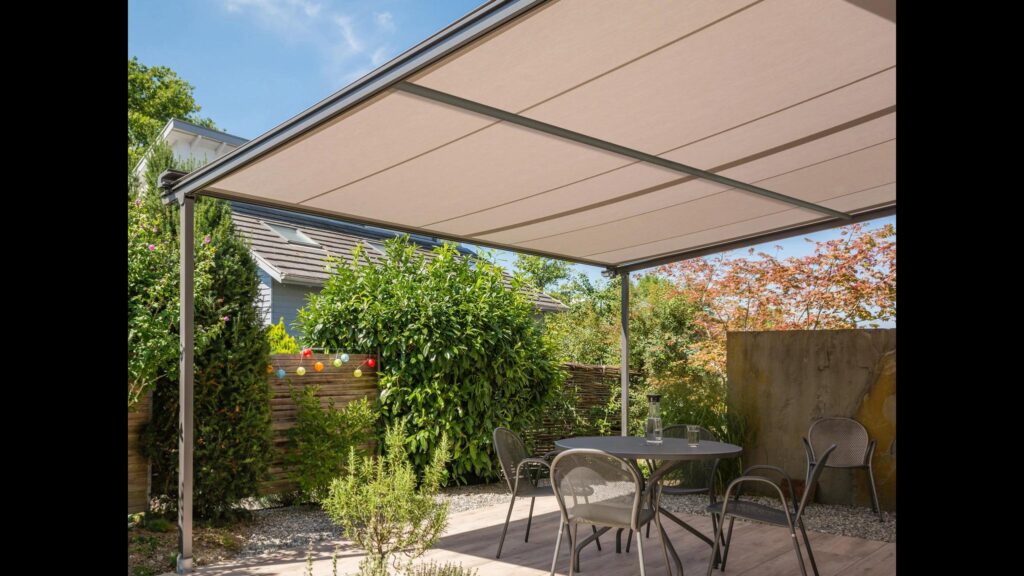

Selecting a retractable awning for a wind-exposed site is a fundamentally different decision than choosing one for a sheltered patio. The Pergolino retractable awning is engineered with structural integrity and outdoor durability in mind, making it a strong candidate for exposed residential and commercial installations. The factors below are ordered for procurement decisions, guiding homeowners, architects, and property managers through the critical evaluation points before committing to a purchase.
1. Assess Your Site’s Wind Exposure Before Specifying Any Product
Wind exposure is not uniform across properties. Rooftop patios, lakefront cottages, and open-concept backyards in Cottage Country consistently experience higher lateral wind loads than sheltered urban courtyards. Before specifying a Pergolino awning, evaluate the site’s orientation, surrounding structures, and seasonal wind patterns.
A site assessment determines whether a wall-mounted or posted configuration is appropriate. The Motorized Pergolino Posted Awning is specifically designed for freestanding installation, making it suitable for open areas where wall attachment is not feasible. Ignoring site exposure at this stage leads to premature fabric stress and frame fatigue.
- Identify prevailing wind direction relative to the awning face
- Note any seasonal wind intensification, particularly near water or elevated terrain
- Confirm whether the mounting surface can support dynamic wind loads
2. Choose the Correct Frame Construction and Mounting Configuration
Frame rigidity directly determines how a retractable awning performs under sustained wind pressure. Aluminum extrusion profiles vary in wall thickness and cross-section geometry, and these differences translate into meaningfully different deflection behaviour under load.
The Pergolino retractable awning uses a robust aluminum frame designed for outdoor permanence rather than seasonal portability. For posted installations, the base anchoring method is equally critical. Concrete footings, surface mounts, and deck-mount brackets each carry different load transfer characteristics. A posted awning that is under-anchored will exhibit lateral movement under moderate gusts, accelerating wear at all pivot and hinge points.
Key procurement questions to ask your supplier:
- What is the recommended anchoring method for this substrate type?
- Has the frame profile been tested under dynamic lateral loading?
- What is the maximum recommended projection for wind-exposed sites?
3. Evaluate Fabric Grade, Weave Density, and UV Stability
Fabric selection is where many buyers underestimate long-term performance risk. In high-wind areas, fabric must resist both tearing under tension and degradation from prolonged UV exposure, since weakened fibres fail at materially lower wind loads than new fabric.
Solution-dyed acrylic fabrics are widely recognised as the industry standard for outdoor awning applications. They retain colour integrity and tensile strength meaningfully longer than coated polyester alternatives. Canadian Shade offers thousands of customization options across fabric selections, allowing buyers to match aesthetic preferences without compromising technical performance.
Best for: Exposed lakefront, rooftop, and open-yard installations requiring long-term durability.
Not for: Budget-first buyers unwilling to invest in commercial-grade fabric weight.
Cost posture: Moderate to higher upfront, materially lower replacement frequency.
4. Confirm Motorization, Sensor Integration, and Retraction Speed
Manual awnings in high-wind environments carry a consistently higher risk of damage than motorized alternatives. A motorized Pergolino awning paired with a wind sensor retracts automatically when gusts exceed a safe threshold, eliminating the human response delay that causes most wind-related awning failures.
Retraction speed matters operationally. A slow-retracting motor leaves fabric exposed during the critical seconds of a wind event. Confirm that the motor specification supports rapid retraction under load, not just smooth operation in calm conditions. Canadian Shade provides installation support and remote location guidance for customers outside direct service areas, ensuring proper motor and sensor commissioning regardless of site location.
- Confirm wind sensor compatibility with the motor controller
- Verify retraction speed under partial load conditions
- Ask whether the sensor threshold is adjustable for your specific exposure level
Choose the Right Pergolino Retractable Awning for Your Site
Selecting the right Pergolino retractable awning for a wind-exposed site is a layered decision. Structural anchoring, fabric grade, and motorized sensor integration collectively determine whether the installation delivers lasting value or recurring repair costs. Canadian Shade’s expertise in premium, Canadian-made shade solutions positions them as a reliable partner for both supply and installation across residential and commercial projects.
Contact Canadian Shade today for professional product guidance, custom options, and installation support designed around site conditions.