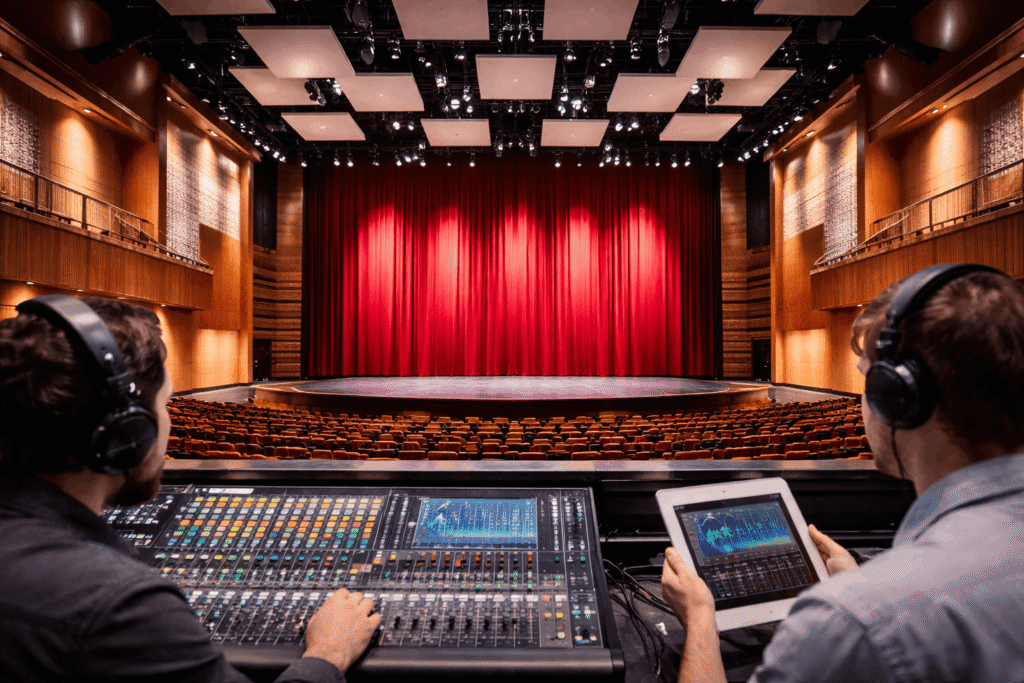

Theatre environments are built around one central expectation: sound must perform flawlessly. Dialogue, music, and subtle acoustic detail need to reach every seat with clarity and consistency, regardless of venue size or performance style. When acoustic conditions fall short, even the most carefully staged production can lose impact through uneven sound coverage, excessive reverberation, or intrusive background noise.
Theatre acoustic design addresses these challenges through engineering-led planning rather than trial-and-error correction. It brings structure, measurement, and predictive analysis to spaces where sound quality is integral to function. From early design coordination to post-construction verification, acoustic performance is treated as a core building system rather than a secondary consideration.
People Also Ask
1. How does theatre acoustic design differ from studio acoustic design?
Theatre acoustic design manages sound distribution across large audience spaces, while studio acoustic design focuses on controlled recording environments with localized sound capture.
2. Can acoustic performance be improved in existing theatres?
Yes. Targeted analysis and selective studio acoustic treatment strategies can significantly improve performance within existing architectural constraints.
What Is Theatre Acoustic Design?
Theatre acoustic design is a specialized discipline focused on managing how sound behaves within performance venues. It governs how sound is generated on stage, how it reflects within the space, how it decays over time, and how it reaches the audience. Unlike conventional room acoustics, theatre acoustics must support dynamic sound sources, variable audience absorption, and changing performance requirements.
This discipline borrows analytical foundations from studio acoustic design, where sound control is tightly managed, but applies them at a much larger scale. The result is a balance between acoustic precision and architectural intent.
Core Principles of Theatre Acoustic Design
Several core principles guide successful theatre acoustic design. Sound must be evenly distributed across seating areas without excessive variation in level or clarity. Early reflections play a critical role in supporting speech intelligibility, while later reflections contribute to perceived warmth and fullness.
Reverberation is carefully controlled rather than minimized. Too little reverberation can make performances feel flat, while too much reduces intelligibility. Absorption, diffusion, and reflection are applied selectively to achieve a controlled acoustic response tailored to the venue’s purpose.
Understanding Performance Metrics in Theatre Acoustics
Objective performance metrics provide measurable benchmarks for theatre acoustics. Reverberation time indicates how long sound persists after the source stops. Clarity metrics evaluate the balance between early and late sound energy, directly influencing intelligibility.
Additional indicators assess background noise levels, spatial uniformity, and audience coverage. These metrics allow acoustic performance to be evaluated quantitatively rather than subjectively, supporting defensible design decisions.
How Theatre Acoustic Design Varies by Performance Type
The acoustic needs of a theatre vary significantly depending on performance type. Drama and spoken-word productions require high speech intelligibility with controlled reverberation. Musical theatre introduces additional complexity by combining vocals, amplified sound, and orchestral elements.
Venues hosting diverse programming often require adaptable acoustic solutions. Concepts drawn from studio acoustic treatment, such as variable absorption and movable reflective elements, allow spaces to adjust acoustic characteristics without permanent alteration.
Architectural Factors That Influence Theatre Acoustics
Architectural form plays a defining role in acoustic performance. Room volume, ceiling geometry, wall angles, and seating configuration influence how sound propagates. Balconies, soffits, and overhangs can either enhance early reflections or create acoustic shadows if poorly designed.
Material selection further shapes sound behaviour. Hard surfaces reflect energy, while softer finishes absorb it. Successful theatre acoustic design integrates architectural expression with acoustic function rather than treating them as competing priorities.
Mechanical and Building Systems Considerations
Mechanical systems often represent the most persistent acoustic risk in theatre projects. HVAC equipment, ductwork, and air movement can introduce background noise that interferes with quiet passages and spoken dialogue.
Engineering-led theatre acoustic design addresses these risks through equipment isolation, vibration control, airflow management, and careful coordination of mechanical layouts. Low background noise levels are established as a performance requirement rather than an afterthought.
Common Design Challenges in Theatre Acoustic Design
Theatre projects face a unique set of challenges. Budget constraints may limit material choices. Architectural features may conflict with acoustic objectives. Renovations must work within fixed geometries and legacy construction.
Another challenge arises from competing expectations. Performers, technical staff, architects, and operators may prioritize different outcomes. Acoustic consultants help navigate these pressures by grounding decisions in measurable performance criteria.
Predictive Modelling and Simulation in Theatre Acoustic Design
Predictive modelling plays a central role in modern theatre acoustic design. Digital simulations evaluate sound propagation, reflection patterns, reverberation behaviour, and audience absorption before construction begins.
These models allow multiple design options to be tested and refined virtually. Risks are identified early, and mitigation strategies are evaluated before they become costly to implement physically.
Integration With Other Building Disciplines
Acoustic performance depends on close coordination with other building disciplines. Structural systems influence vibration transmission paths. Lighting grids, rigging systems, and ceiling assemblies affect sound reflection and diffusion.
Effective theatre acoustic design requires ongoing collaboration throughout the design process. Acoustic intent must be preserved as systems are integrated and details evolve.
Acoustic Design Strategies for Renovations vs New Theatres
New theatre projects offer greater flexibility to shape acoustic outcomes holistically. Geometry, volume, and material selection can be optimized from the outset to meet performance targets.
Renovation projects require a more targeted approach. Existing structures often limit intervention options, making selective studio acoustic treatment techniques particularly valuable. Detailed analysis determines where adjustments will deliver meaningful improvement without extensive reconstruction.
Testing and Performance Verification After Construction
Post-construction testing confirms whether design objectives have been achieved. Measurements evaluate reverberation time, background noise, clarity, and coverage consistency under real operating conditions.
Performance verification provides confidence to owners, operators, and performers while documenting compliance with design intent. It also identifies opportunities for fine-tuning before venues enter full operation.
Why Early Theatre Acoustic Design Reduces Long-Term Risk
Early integration of theatre acoustic design reduces uncertainty across the project lifecycle. Acoustic considerations influence room proportions, mechanical layouts, and material choices when changes are still feasible.
When sound performance is engineered from the beginning, projects avoid reactive corrections, scheduling delays, and compromised outcomes. Long-term operational reliability improves as a result.
Theatre Acoustic Design as a Foundation for Performance Excellence
Performance venues succeed when sound supports artistic expression without distraction. Theatre acoustic design provides the technical foundation required to balance clarity, warmth, and consistency within complex architectural environments. Through engineering analysis, predictive modelling, and verification, acoustic outcomes become intentional rather than incidental.
Valcoustics delivers consulting-engineer-led acoustic design services for theatres, auditoriums, and performance spaces. By integrating acoustic strategy early and validating performance after construction, Valcoustics supports venues where sound quality is a controlled, reliable asset.
Contact Valcoustics to discuss theatre acoustic design requirements for upcoming performance projects.