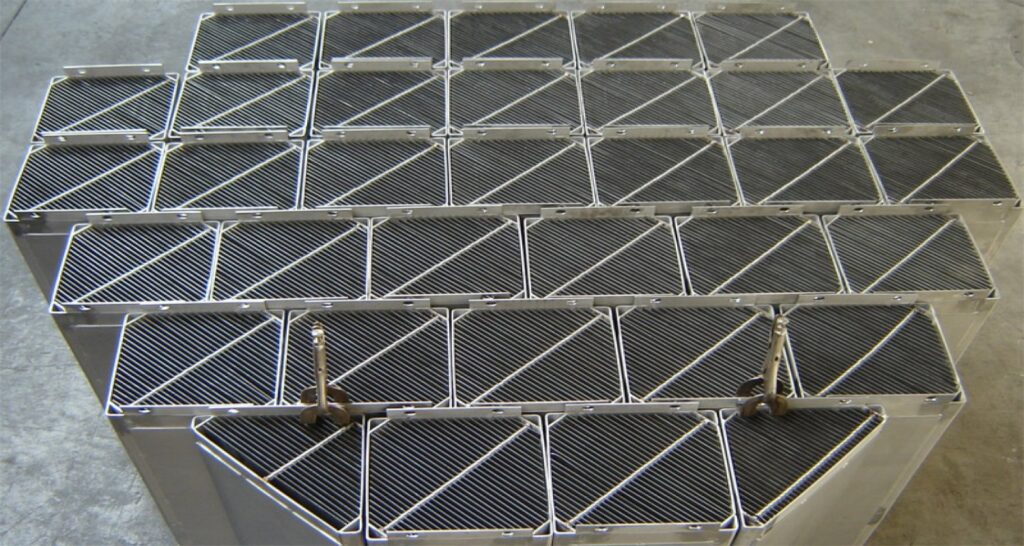

Liquid–liquid separation remains a fundamental unit operation throughout chemical processing, refining, and industrial water treatment systems. In many of these environments, immiscible liquid phases must be separated with sufficient reliability to maintain product purity, protect downstream equipment, and sustain steady process operation. In practice, however, fine dispersed droplets frequently remain entrained within the continuous phase, particularly in systems subject to mixing, shear, or turbulent flow conditions.
Under such circumstances, droplet removal becomes increasingly difficult through gravity alone. For this reason, engineered liquid coalescers, including structured coalescer pads and liquid-liquid coalescer systems, are commonly employed to improve separation efficiency and promote the removal of fine dispersed droplets.
A comparison between traditional gravitational settling and modern liquid coalescer technology illustrates how engineered coalescing media significantly improve droplet capture, droplet growth, and phase disengagement in demanding industrial separation applications.
Fundamentals of Liquid Coalescers and Droplet Separation
In dispersed liquid systems, droplet separation efficiency is strongly governed by droplet diameter. Small droplets—often in the micron range—possess extremely low settling velocities and may remain suspended in the continuous phase for extended periods.
Liquid coalescers are designed to address this limitation by promoting droplet growth prior to bulk phase separation. Within a liquid-liquid coalescer, the process stream passes through structured coalescing media—often a fibrous or filamentous coalescer pad—that provides extensive surface area for droplet capture and interaction.
As dispersed droplets contact the fibers within the coalescing media, surface forces promote adhesion. Subsequent collisions between neighboring droplets lead to coalescence, forming progressively larger droplets within the structure of the pad. Once droplets exceed a critical size, buoyancy forces overcome surface adhesion, and the droplets disengage from the media.
The resulting increase in droplet diameter substantially improves gravitational separation in the downstream settling zone. In this manner, liquid coalescers enhance droplet removal efficiency by transforming fine dispersions into droplets large enough to separate rapidly from the surrounding liquid phase.
Gravitational Settling: The Conventional Approach
Gravitational settling represents the most traditional method of separating immiscible liquids. The mechanism relies entirely on density differences between phases. Over time, heavier droplets descend while lighter liquids rise, ultimately forming stratified layers.
Although this approach is conceptually straightforward, the effectiveness of gravitational separation depends heavily on droplet size distribution and hydraulic residence time. Very small droplets exhibit extremely slow settling velocities, particularly in systems with continuous flow or residual turbulence.
As a result, gravity separators must often be designed with large vessel volumes to provide adequate residence time for droplet migration. Even under these conditions, extremely fine droplets may persist in suspension, limiting separation efficiency and potentially affecting downstream operations.
Coalescer Pad Technology in Liquid–Liquid Coalescers
Engineered coalescer pad technology improves liquid–liquid separation performance by actively promoting droplet coalescence within the process stream. Rather than relying solely on passive gravitational settling, a liquid-liquid coalescer conditions the droplet population during passage through the coalescing media.
A properly designed coalescer pad incorporates high-surface-area fiber structures that facilitate droplet interception and merging. As the fluid flows through the pad, dispersed droplets accumulate along the fibers, where repeated collisions encourage coalescence.
Droplets gradually increase in diameter until they detach from the coalescing media. At that point, the enlarged droplets separate readily by gravity. This mechanism allows liquid coalescers to remove droplets significantly smaller than those typically separated by gravity alone.
The result is a separation system capable of efficiently removing fine dispersed phases while operating with shorter residence times and smaller equipment footprints.
Separation Efficiency and Operational Characteristics
From a process engineering perspective, the principal distinction between gravitational settling and liquid coalescer systems lies in how each approach addresses fine droplets.
Gravity separators operate passively and depend entirely on the droplet size distribution entering the vessel. If droplets are sufficiently large, separation proceeds effectively. When droplets are extremely fine, however, separation becomes slow and incomplete.
By contrast, liquid coalescers actively modify the droplet distribution during processing. The coalescer pad promotes droplet growth, shifting the dispersion toward larger droplets that respond readily to buoyancy-driven separation.
This mechanism provides several operational advantages frequently sought in modern process design:
- Improved removal of micron-scale dispersed droplets
- Greater separation efficiency in liquid–liquid systems
- Reduced equipment size compared with large gravity settlers
- Shorter residence time requirements
- More stable operation under variable flow conditions
For high-throughput systems or applications involving persistent dispersions, liquid-liquid coalescer technology often provides a more practical and reliable separation solution.
Industrial Applications for Liquid Coalescers
Efficient droplet removal is essential in numerous industries where immiscible liquids must be separated from process streams. Liquid coalescers are commonly applied in:
- Petrochemical and refining operations
- Chemical manufacturing processes
- Industrial wastewater treatment systems
- Hydrocarbon–water separation applications
- Process streams containing fine-dispersed liquid contaminants
In each case, the selection of an appropriate liquid-liquid coalescer or coalescer pad system depends on several process variables, including droplet size distribution, interfacial tension, fluid viscosity, flow rate, and the required separation efficiency.
Where fine droplets persist or where compact separation equipment is required, engineered coalescing media often provide significant advantages over gravity settling alone.
Advanced Liquid Coalescer Solutions from Kimre™ Clean Air Technology
Reliable droplet separation plays an essential role in maintaining stable and efficient process operations. While gravitational settling offers a basic separation mechanism, liquid coalescers equipped with engineered coalescer pads provide superior performance in applications involving fine dispersed droplets.
Advanced separation technologies developed by Kimre™ Clean Air Technology utilize engineered coalescing media to promote droplet growth, improve liquid–liquid separation efficiency, and support consistent system performance across demanding industrial environments.
Organizations seeking improved liquid-liquid coalescer performance, enhanced droplet removal efficiency, and dependable coalescer pad technology can connect with Kimre™ Clean Air Technology to learn how engineered separation systems help protect equipment, maintain fluid purity, and support reliable industrial processing.