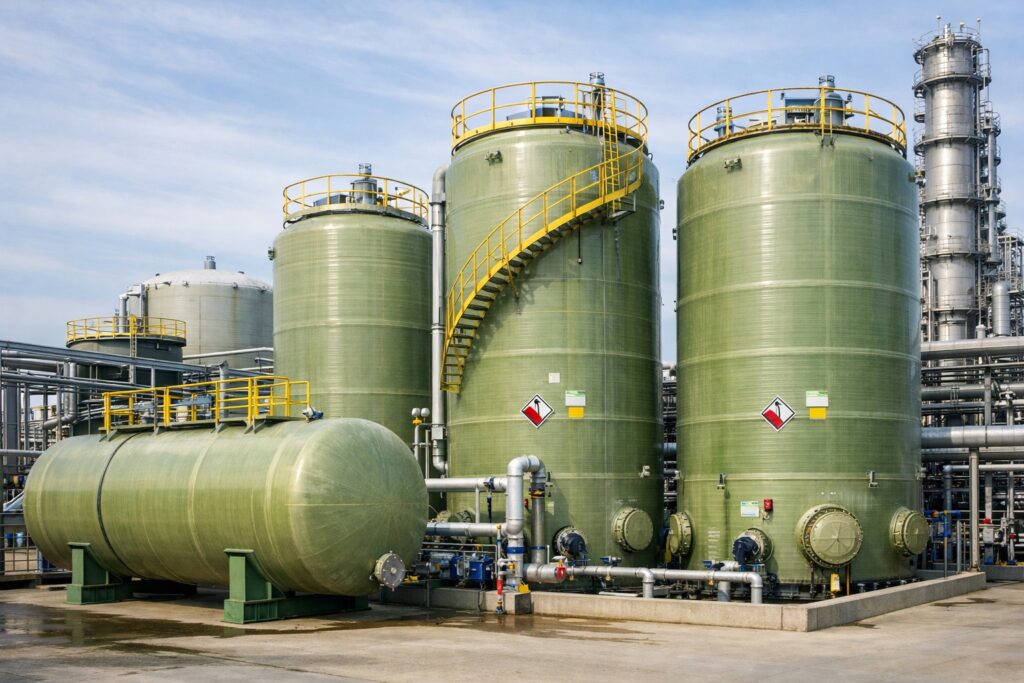

As industries scale and environmental conditions grow harsher, traditional tank materials are struggling to keep up. In sectors where chemical compatibility, strength, and long-term durability matter most, fiberglass tanks are becoming the go-to solution for safe and efficient bulk storage. Lightweight, non-corrosive, and highly customizable, fiberglass-reinforced plastic (FRP) offers the performance that steel and polyethylene often can’t match.
Engineered bulk storage tanks are built to meet the challenges of today’s high-demand applications—from chemical processing to wastewater management and agricultural supply systems.
Benefits of FRP Over Steel and Polyethylene in Harsh Environments
While steel and polyethylene have long served industrial storage needs, both present limitations when exposed to aggressive chemicals, high UV levels, or severe temperature shifts. FRP tanks for chemical storage, on the other hand, provide a powerful alternative with several distinct advantages:
- Corrosion resistance: Unlike steel, fiberglass won’t rust, flake, or degrade when exposed to acids, alkalis, or saltwater.
- UV stability: Polyethylene tanks can degrade under constant sunlight, while FRP maintains structural integrity outdoors.
- Lightweight construction: Fiberglass is easier to transport and install than steel, reducing labor and equipment costs.
- Higher temperature tolerance: FRP can handle a broader range of thermal conditions, making it ideal for both hot and cold climates.
- Design flexibility: FRP tanks can be customized in shape, size, and resin systems to suit specific applications.
These benefits make fiberglass a smart choice for environments where chemical exposure, weather extremes, or heavy-duty performance are a daily reality.
Common Industries Using Fiberglass Bulk Tanks
Fiberglass reinforced plastic (FRP) tanks serve a wide range of industries that require secure, long-term fluid storage. These include:
- Chemical processing and manufacturing: For storing acids, solvents, resins, and caustics
- Water and wastewater treatment: For clean water, greywater, stormwater, and sludge
- Agriculture and fertilizer storage: For storing liquid nitrogen, UAN, and micronutrients
- Oil and gas: For containment of brine water, drilling fluids, and treatment chemicals
- Food and beverage: For process water, CIP fluids, and syrups
- Pulp and paper: For managing bleach, lime slurries, and wash water
Each of these sectors depends on tanks that can safely contain aggressive or sensitive substances without leaching, contamination, or structural failure.
Key Performance Specs: Tensile Strength, Corrosion Resistance
Fiberglass is not just a corrosion-resistant option—it is a high-performance material with engineering-grade properties. Some key specifications that make FRP tanks for chemical storage stand out include:
- High tensile strength: Fiberglass has excellent mechanical strength relative to weight, outperforming many metals in tensile load scenarios.
- Flexural strength: FRP tanks can absorb shock and stress without cracking, making them ideal for sites with shifting ground or vibration.
- Long-term chemical resistance: Resin systems can be tailored to handle acids, bases, oxidizers, and solvents.
- Thermal stability: FRP tanks maintain structural integrity at higher temperatures than polyethylene and are more stable than metal in freeze/thaw cycles.
- Low conductivity: Useful for electrical isolation in specialized industrial setups.
Each tank is engineered to meet design standards such as ASTM D3299 and D4097 for vertical and horizontal configurations, ensuring consistent performance and regulatory compliance.
Tank Customizations for Chemical Compatibility and Insulation
One of the most valuable aspects of FRP construction is the ability to customize each tank for specific operational needs. Customizations may include:
- Resin selection: Vinyl ester, epoxy, or polyester resins selected based on chemical compatibility
- Liner systems: Optional internal linings for added barrier protection
- Double-wall construction: For secondary containment in hazardous material applications
- Thermal insulation: Integrated wall insulation or heat trace systems to maintain fluid temperature
- Baffles or agitator mounts: For process mixing, blending, or temperature distribution
- Manways, nozzles, and flanges: Located for easy access, inspection, and process integration
These customizations ensure that each FRP tank is not only chemically compatible but also aligned with the facility’s workflow and safety protocols.
Real-World Applications: Water Treatment, Chemical Storage, Agriculture
Fiberglass tanks are proving their value every day across a range of use cases.
In municipal water treatment plants, FRP tanks are used to store chlorine, alum, and ferric chloride. These chemicals are aggressive and would quickly degrade steel or poly tanks without proper liners. With fiberglass, utilities get long-term containment with minimal maintenance.
In industrial chemical plants, bulk tanks store reactive solvents or highly viscous liquids. FRP tanks can be designed with heating coils or bottom-drain configurations to support efficient emptying and processing.
In agriculture, fiberglass tanks store fertilizers and pesticides that would corrode metal or absorb into polyethylene. FRP tanks are also used for liquid feed systems, rainwater collection, and irrigation holding systems, supporting both large commercial farms and rural installations.
Each application highlights the versatility and reliability of fiberglass, especially in settings where durability directly impacts operational uptime and product quality.
Long-Term Cost Savings and Maintenance Tips
Although initial investment in fiberglass may be higher than in polyethylene, the total cost of ownership over time is significantly lower. FRP tanks require minimal maintenance, are highly resistant to external and internal degradation, and offer decades of reliable service.
To extend the life and performance of bulk storage tanks:
- Perform regular external inspections for surface wear or UV damage
- Check fittings and gaskets annually for tightness and integrity
- Flush and clean interiors as needed based on stored contents
- Document any changes or repairs for warranty and compliance purposes
- Avoid abrasive tools or high-impact machinery around the tank structure
Many facilities report service lives of 25 years or more from well-maintained fiberglass tanks, making them a preferred choice for long-term storage projects with strict budgetary controls.
Conclusion
As industries seek higher performance and longer-lasting infrastructure, fiberglass reinforced plastic (FRP) tanks continue to set the standard for reliable bulk storage. They outperform steel and polyethylene in corrosive, high-impact, and outdoor environments, while offering unmatched customization for a wide range of industrial applications.
From chemical processing to water treatment and agriculture, the flexibility and resilience of fiberglass water tanks provide businesses with storage systems that won’t compromise under pressure.