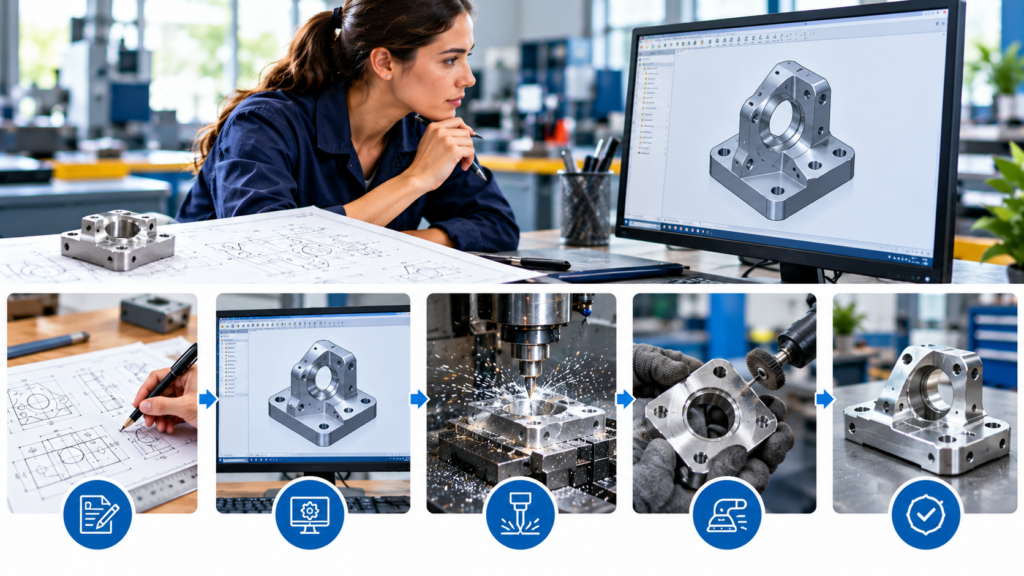

You send a drawing on a Tuesday morning. By the time you finish lunch that same day, the file has landed in an inbox somewhere, and the future is uncertain. For most buyers, the shop floor is a black box when it comes to custom metal laser cutting.
Nine steps separate the moment a file lands in our inbox and the moment we inspect the finished part as ready for shipment. The process begins with the drawing, and delays often start there. Having the complete set of files, including the necessary material call-outs, and being available to answer questions promptly will keep custom laser-cut parts flowing.
This post attempts to open the black box. It follows one part through nine steps. We’ll review each step, identify potential delays, and point out what you, as a buyer, can do to help keep a laser cutting project on schedule.
People Also Ask
How long does custom metal laser cutting take?
Duration depends on file quality, material availability, quantities, and any additional forming or welding. Cutting may be the quickest step. Inspection, preparation, and post-cutting operations take longer.
What file format works best for laser cutting?
Submit a DXF or DWG file at full size for flat parts and a STEP file for formed parts. Include a PDF drawing showing important dimensions and tolerances.
Do I need a finished drawing to order custom laser cut metal parts?
No. The technical team at WeldFlow Metal Products creates your production drawings from your concept, sketch, or sample.
Step One: Your Drawing Arrives
The job starts when your request lands through the Request for Quote page or sales@weldflowmetal.com. We log the part number, revision, material, and quantity.
Revision control matters more than most buyers think. If two versions of the same drawing arrive a day apart, the revision letter decides which one gets cut. Mark it clearly on every file.
Step Two: We Review It For Manufacturability
Before anyone programs a cut, an engineer checks the part against laser cutting design guidelines and the forming steps ahead. Ten minutes here saves hours on the floor.
What We Check For
- Closed contours, with no duplicate lines stacked on top of each other
- Units. A part drawn in millimetres but read as inches comes out 25.4 times too large, and nobody notices until the sheet is on the machine.
- Holes and slots sized for the material thickness
- Bend reliefs and a flat pattern matched to the press brake
- Text converted to outlines
When We Come Back With Questions
We call or email when there is a conflict or omission. A thickness differs in the notes from the title block. A tolerance is tighter than the feature requires. A formed part comes without a flat pattern.
Good custom metal laser cutting design anticipates these questions before the drawing leaves your desk. If questions arise, a same-day reply keeps your job on schedule. A delayed reply postpones your start date.
Step Three: Programming And Nesting
The software converts your geometry into a cutting path. The programmer positions lead-ins away from important edges so the tiny mark designating where each cut originates will not appear on a sealing surface or an exposed edge.
Nesting follows. The program nests parts on the sheet to minimize scrap, and small tabs keep each part securely in place until it is time to remove it. Brushed stainless steel imposes one constraint: Every part must be oriented with the grain, which can reduce the number of parts per sheet.
Step Four, Material Selection And Preparation
WeldFlow Metal Products keeps most raw material in inventory, which shortens wait times for common grades. Materials for custom laser-cut metal parts include cold-rolled steel, hot-rolled pickled and oiled steel, stainless steel, aluminum, galvanized steel, brass, and copper.
The operator confirms grade, thickness, and finish against your drawing before loading. Coated or polished sheets keep their protective film, so the surface reaches you without scratches.
Step Five: Cutting
The cut is made on an AMADA ENSIS EN3015AJ 9kW fiber laser. The machine features an adjustable laser beam for every thickness, eliminating the need to change lenses, and a 16-station nozzle changer that automatically swaps nozzles between jobs. Learn the benefits of switching to the Fiber Laser EN3015AJ-9KW for sheet metal work.
The assist gas shapes the edge and is important for certain materials, such as mild steel, where oxygen can speed up the process. For stainless steel and aluminum, nitrogen is used as the assist gas to prevent oxidation on the edges of cut parts, which would otherwise have to be sanded off before powder coating.
A good rule of thumb for any laser cutting of custom metal parts is to check the first part before starting the job. If a programming error produced a defective piece, it would take only minutes to fix. If it was not discovered until the fiftieth piece, it would have already cost a sheet of metal.
Step Six: Removing Parts From The Sheet
The operator frees each segment from the sheet skeleton. Each tab leaves a tiny nub on the edge. On a hidden flange, nobody cares. On a cosmetic edge, the nub shows. Specify which edges are visible; the programmer places tabs accordingly.
Parts are then sorted and labelled by part number, so a mixed nest of six designs never becomes a guessing game at the brake.
Step Seven: Deburring And Edge Finishing
Edges are prepared to suit the drawing. Tab nubs are removed, and sharp edges are rounded at points that will be touched by hands or paint.
If coating is required, WeldFlow Metal Products coordinates chrome plating, powder coating, anodizing or wet paint through approved vendors.
Step Eight: Forming, Welding Or Assembly If Needed
Many custom laser-cut metal parts leave the laser as flat blanks and come back as brackets, boxes, or cabinets. WeldFlow Metal Products forms parts on six press brakes, including an AMADA HG8025 M15. The welding team handles MIG, TIG, spot welding, and brazing, and automated equipment inserts studs, standoffs, and nuts.
Keeping these steps in one building means no extra freight between suppliers and one point of contact for the whole part.
Step Nine: Inspection Before Dispatch
We inspect each component before shipping. Inspectors verify critical dimensions, hole location, bends, and surface finish against your drawing.
Packaging is the final step in the quality process. A stainless panel scratched during shipment will fail inspection when it arrives at your facility.
How Long The Process Takes
The laser moves quickly, but many hours of review, scheduling, forming, and finishing must happen before the process can begin.
Flat parts in stocked materials move fastest; a welded, powder-coated assembly takes longer because the coating process at an outside vendor creates its own queue. Be sure to specify a delivery date in your quote so we can plan accordingly.
What Slows A Job Down
Five problems cause most delays:
- Files missing a flat pattern, a thickness, or a revision letter
- Questions left unanswered for days
- A special grade or finish needing a separate order
- Design changes after programming starts, which restart nesting and sometimes waste cut material
- Busy finishing vendors
Only the last one sits outside your control.
Prototypes Against Production Runs
Prototypes need no hard tooling, so custom metal laser cutting is the natural first step for a new design. Change a slot on Monday, and the revised part follows soon after.
Production runs reward a frozen design. The same program cuts the same part every time, and larger batches nest more efficiently. For high volumes with repeating holes or louvres, WeldFlow Metal Products sometimes moves features to a CNC turret punch.
Here is the tradeoff. A design optimized only for the prototype stage often costs more in production. Raise volume plans early, and we will flag choices worth changing while changes are still free.
How To Speed Up Your Job
Follow these laser cutting design guidelines before you hit send:
- Export DXF or DWG at full scale, plus a STEP model for formed parts.
- Close every contour and delete duplicate lines.
- Convert text to outlines.
- State material, grade, thickness, finish, and grain direction.
- Include the flat pattern and mark cosmetic edges.
- Give quantity, deadline, and any welding, hardware, or coating needs.
- Name one contact who answers questions the same day.
Keeping Your Custom Metal Laser Cutting Job On Track
Your part goes through nine sets of hands before it reaches your dock. Each stage depends on the previous one, and almost all delays can be traced back to step one.
Send a complete file, answer questions promptly, and provide volume plans early. Those three things, and your custom laser-cut metal parts will arrive on time and right the first time.
Have a drawing ready? Send it today, while your preferred delivery date is still open.
Frequently Asked Questions
What is custom metal laser cutting?
Custom metal laser cutting uses a focused fiber laser to cut parts from sheet metal to your drawing, with no hard tooling needed for new designs.
Which materials does WeldFlow Metal Products cut?
Mild steel, stainless steel, aluminum, galvanized steel, satin coat, brass, and copper run on the fiber laser. Acrylic and MDF are processed separately.
What happens if my file has errors?
We contact you with specific questions before cutting. Fixing a file at review takes minutes. Fixing parts after cutting costs material and days.
Do you form and weld laser-cut parts?
Yes. WeldFlow Metal Products forms, welds, and assembles parts in its Mississauga facility, with approved vendors handling coatings.
How do I order custom laser-cut metal parts?
Send your files through the Request for Quote page, email sales@weldflowmetal.com, or call 1 866 848 3641.