
High-capacity laundry environments depend on systems that can operate without pause. In these settings, an industrial dryer machine is not a convenience. It is a core production asset. Drying failures affect throughput, labor planning, and downstream handling across the entire facility.
As facilities scale, confusion often arises between true industrial drying systems and standard commercial-grade units. While both perform the same basic function, their design intent, construction, and performance limits differ in ways that directly impact long-term reliability and operating cost.
Understanding High-Capacity Laundry Facility Requirements
Large-scale laundry operations process continuous volumes of textiles under fixed timelines. Dryers must handle heavy loads, extended runtimes, and repeatable performance without recovery periods.
These facilities prioritize uptime, predictable cycle completion, and mechanical durability. Equipment selection must align with production reality rather than short-term cost considerations.
What Defines an Industrial Clothes Dryer?
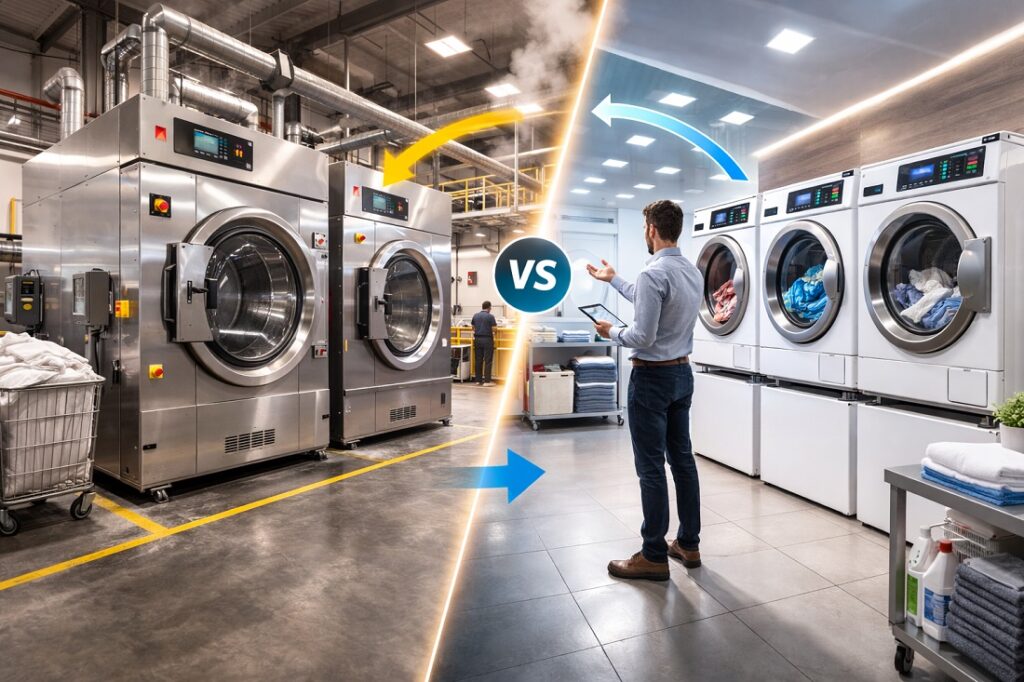
An industrial clothes dryer is engineered for constant operation under demanding conditions. These systems are designed with oversized components, reinforced frames, and airflow systems capable of supporting large drum volumes.
Industrial dryers focus on thermal consistency, structural integrity, and service accessibility. Every feature supports long operating hours and uninterrupted production.
What Defines a Standard Commercial Dryer?
Standard commercial dryers are typically built for moderate workloads and intermittent use. While suitable for smaller operations, these systems often rely on lighter construction and shorter duty cycles.
In high-capacity facilities, these limitations become visible through increased wear, longer dry times, and higher maintenance frequency.
Capacity and Load Handling Capabilities
Industrial dryers are built to process heavy, dense loads without performance loss. Drum size, airflow volume, and mechanical drive systems are scaled accordingly.
Standard commercial systems often struggle with oversized or consistently heavy loads, leading to uneven drying and increased cycle repetition.
Duty Cycle and Continuous-Use Performance
An industrial laundry dryer is designed for continuous operation across multiple shifts. Bearings, motors, and heat systems are selected to withstand sustained use.
Standard commercial units are typically rated for shorter duty cycles, increasing downtime risk when pushed beyond intended limits.
Heat Generation and Airflow Design
Industrial dryers rely on high-volume airflow and controlled heat distribution to remove moisture efficiently from large loads. Air paths are engineered to prevent bottlenecks and thermal stress.
Standard systems often lack the airflow capacity required for uniform drying at scale.
Control Systems and Process Accuracy
Industrial dryers use robust control platforms focused on repeatable results and system protection. These controls prioritize consistency over convenience features.
Simpler control architectures in standard systems may limit process precision in high-output environments.
Energy Management at Industrial Scale
Energy efficiency in industrial drying comes from airflow efficiency, heat retention, and cycle consistency. Reduced rework lowers total energy consumption across operations.
Systems not designed for scale often waste energy due to extended runtimes and inconsistent performance.
Mechanical Construction and Durability
Industrial dryers feature reinforced frames, heavy-duty drums, and industrial-grade drive components. This construction minimizes vibration and structural fatigue.
Lighter construction in standard systems accelerates wear under constant load.
Maintenance, Serviceability, and Downtime Risk
Industrial dryers are built for access. Components are positioned to reduce service time and simplify preventive maintenance.
Limited access in non-industrial systems often increases repair duration and labor cost.
Safety Systems and Operational Risk Control
Industrial dryers incorporate layered safety systems designed for high-heat, high-load environments. These features protect equipment, operators, and facilities.
Safety components in lighter systems may experience higher failure rates under industrial stress.
Lifecycle Cost Considerations
Initial equipment cost represents only a fraction of total ownership expense. Industrial dryers typically deliver longer service life, fewer breakdowns, and lower downtime costs.
Frequent repairs and replacement cycles increase the total cost for non-industrial systems.
Application Scenarios in High-Capacity Facilities
Industrial dryers support healthcare, correctional, hospitality, and large institutional laundry operations where consistency and uptime are non-negotiable.
Facilities operating at scale benefit from equipment designed specifically for these conditions.
Common Mistakes When Specifying Dryers for High-Capacity Use
Misjudging duty cycle requirements, underestimating load weight, and prioritizing upfront cost often lead to premature equipment failure.
Specification decisions must align with real production demands.
How to Select the Right Dryer Type for a High-Capacity Facility
Selection should focus on load volume, operating hours, airflow requirements, and long-term serviceability. Matching equipment design to facility demand reduces operational risk.
Feature-Driven Decisions That Protect Long-Term Performance
High-capacity facilities require drying systems built for sustained output, not intermittent use. Choosing the right tumble dryer machine configuration protects productivity, reduces downtime, and supports long-term reliability. Consolidated Laundry Machinery delivers industrial drying solutions engineered for demanding environments.
Contact Consolidated Laundry Machinery today to discuss equipment built for continuous performance.